“As the Alpine climber’s ambition is to make the ascent of Mont Blanc, so the great aim of the Dartmoor explorer is to visit Cranmere.” William Crossing, 1905.
In a moment of relaxed boredom I found myself skimming through a book for an unexpected hour or two, stopping frequently to read passages written in delightful Victorian prose. The book was a guide for ramblers who might want to stop at various spots on Dartmoor to discover unexpected mystery and rugged stark beauty. The book was written in an age when people were free to take time to immerse themselves in a landscape and to explore, discover and learn. Those for whom Dartmoor was out of reach would gain a powerful sense of a powerful landscape without the need to leave home.
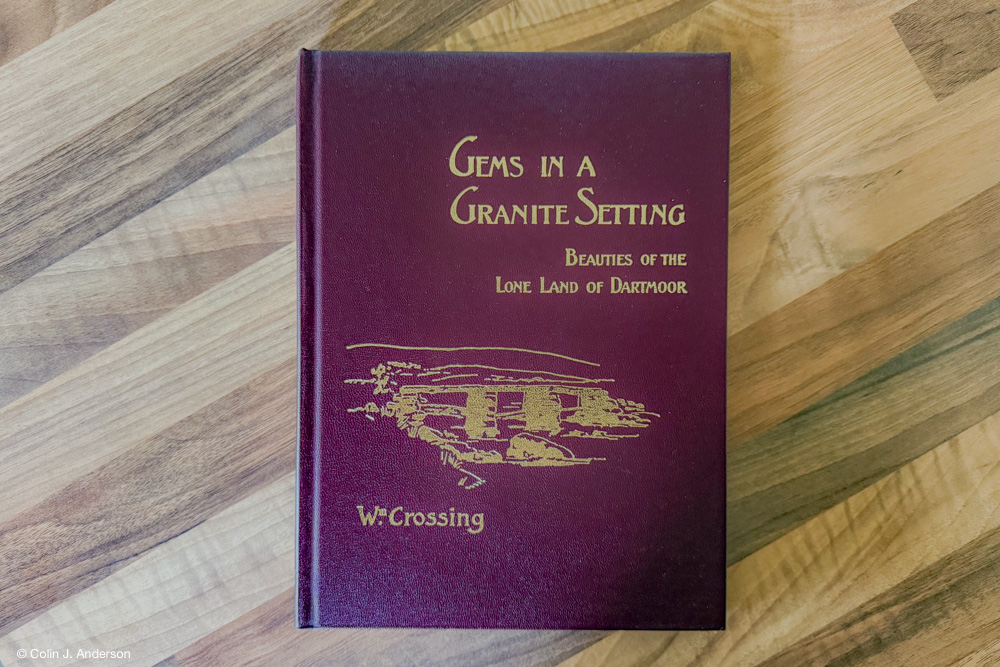
The book in question is Gems In A Granite Setting, published in 1905 and drawing on Crossing’s explorations of the late 19th. century. In 1986 a fine quality facsimile edition was published and, since it was a ‘limited edition’ I snapped it up, despite the relatively high price.
The author – William Crossing – will be well known to anyone born in Devon or who takes a keen interest in Dartmoor. The name was, and hopefully still is, synonymous with Dartmoor.
Crossing takes us to many of the well-known places on the moor: Wistman’s Wood, Fingle Bridge, Grim’s Pound, Lustleigh Cleave – and Cranmere Pool. The description of the latter drew my interest as I suspect that most people, then and now, might feel a tinge of disappointment having made the effort to reach it. Crossing makes the point that it is not necessarily the destination that provides wonder and inspiration, but the journey to get to it.
“…however unattractive Cranmere may be in itself, the ramble thither has taken him through some of the most solitary parts of Dartmoor, and has enabled him to look upon primeval Nature – to see her in her rudest garb”.
Cranmere is not a menhir or a tor – or any object that is as striking as it is obvious – but an unassuming pool in a peat-bog that you encounter after a walk of some miles. Quite apart from the journey, and any disappointment that may be felt upon arrival, there is a certain mystery attached to unexpectedly stumbling upon the destination. Another passage from the book:
“A good deal has been written about the difficulty of finding Cranmere, and ‘traveller’s tales’ have been told of the ignorance of the Moormen concerning it. But there is nothing surprising in the fact that strangers should fail to discover it, particularly when it is remembered that it cannot be seen until one is within a few yards of its brink.”
Does that not make you want to make the journey? Even at the end of the 19th. century Crossing notes that once upon a time Cranmere would have been worthy of a visit in its own right in order to soak up its bleak beauty:
“Time was when this black, peaty hollow was filled with water, upon the surface of which, when ruffled by the mountain breeze, the reflected rays of the sun sparkled like myriads of diamonds, and brightened the face of the grim old desert.”
Sadly, and in my experience at least, travel books, if that is what this is, rarely contain such evocative descriptions. And, the thing about Dartmoor, is that most of the places described in the book, including Cranmere, have changed little since the 19th. century. You can look upon them and see what Crossing saw, should you take the time and trouble to engage with the moor, rather than simply drive through it and stray but a short walk from the road.

Leave a Reply