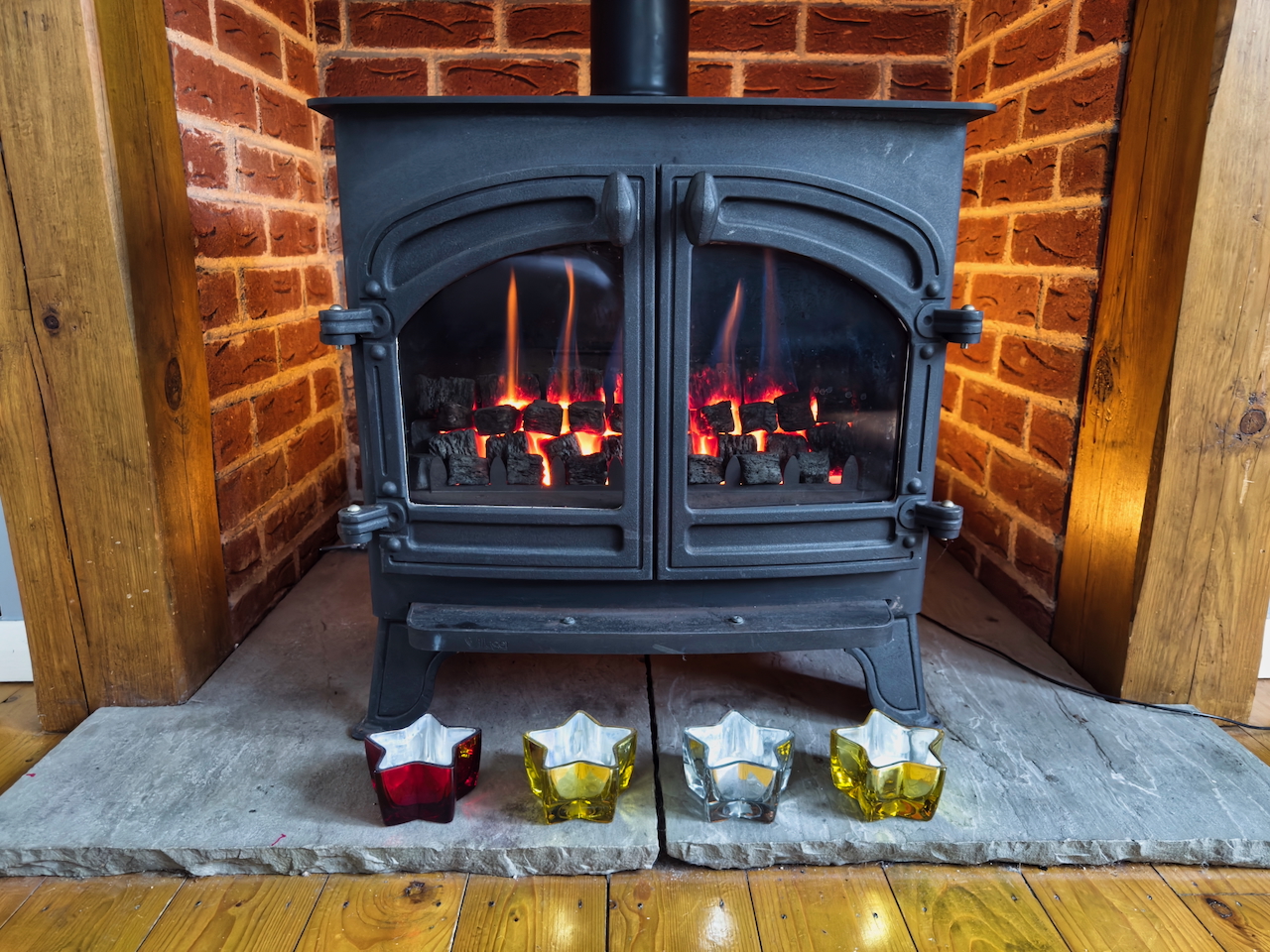
This is a substantial update on an article first posted in April 2025. Note: all costings are for fuel only and do not include the Standing Charge.
Because the gas fire is so expensive to run – when it is off – it has been dormant for over a year. However, with the onset of autumn and in particular Storm Austen I decided to try an experiment aimed at keeping warm on the one hand and minimising heating costs on the other. I must as I am on a low income and am finding it increasingly difficult to make ends meet.
My theory is this: during autumn and early spring, when it is not very cold outside but chill enough to require some form of heating, would the optimal solution be to have the gas fire on when required during the day and the central heating on only at night? Would this save money on my gas bill? I accept that on cold days during the winter the gas fire would be superfluous as the central heating would need to be on for much of the day. An important factor to take into consideration is that it is fiendishly difficult to get the pilot light going on my particular gas fire, a disincentive to switching it ‘right off’ rather than just ‘off’. This will not, of course, apply to all – or perhaps even most – gas fires.
My home has a central heating system covering the whole home and a gas fire in the living room. In a real sense the gas fire is purely decorative. The central heating provided by the landlord consists of a 20 year-old and very energy-inefficient gas condensing combi boiler with a mixture of radiators that are, on the whole, inappropriately sized for the rooms in which they are placed. The TRV’s (thermostatic radiator valves) do not function correctly and the room thermostat is located incorrectly, which does not really matter because it too does not function correctly.
My home is very poorly insulated – a very important factor to take into consideration as heat is lost more rapidly through the roof and walls compared to a well-insulated home. This will, in the case of a CH boiler, require the heating system to modulate more often and therefore use more energy.
One advantage of the gas fire compared to the central heating system is that it does not require electricity to operate so, in the event of a blackout I have a source of heat and can even warm food on the top of it!
I have now established that when the gas fire is ‘off’ – but with the pilot light ‘on’ – the appliance consumes a tad under 0.2kWh, which equates to 4.8kWh per day. Remember that is when it is off. My current gas tariff (Octopus) is 0.546p/kWh, so a heater that is off is costing me £0.26 per day or £7.97 a month. In September 2026 my daily average energy consumption (gas & electricity) was 5.5kWh at a cost of £1.97; with the pilot light ‘on’ that average daily cost would have been £2.23.
The experiment I conducted was for one day only, so indicative rather than conclusive. I had the gas fire ‘on’ for approximately 4 hours in the afternoon at a total cost of £0.78 and the central heating ‘on’ in the evening at a cost of £0.63, giving a total cost for the day of £1.41. As you would expect, each system needs to work harder initially to raise the temperature of the room or house, after which it will modulate (if working properly) up and down to maintain the set temperature. This is important because turning an appliance on and off during the day rather than allowing it to cycle can use more energy.
The gas fire was ‘on’ for 4 hours and consumed 14.12kWh in that time, 43% of which was used in 90 minutes to raise the temperature to a point where it could reduce the call on gas. Remember it is heating just one room, albeit a large one at 21.7 square metres. I turned it off and the temperature in the living room was 20ºC, but the cast-iron fire continued to emit heat for some time, with the temperature declining slowly to 18ºC.
Three hours after switching the gas fire off I switched the central heating on. The living room was still comfortably warm but the rest of the house was at about 16ºC. The CH consumed 11.51kWh in total over just 90 minutes, using 52% of this in the first half-hour to get the boiler up to speed. It cycled off after 90 minutes because it had reached the set-point temperature of 18ºC around the home.
I have no doubt that pre-warming the living room – the largest room in the house – with the gas fire led to the CH boiler not having to work so hard to raise temperatures in the evening. My conclusion therefore is that, when it is chilly rather than cold I am better off having the gas fire on during the day, so long as I stay in that room for most of the time. I have to say, I found that afternoon with the fire on rather pleasant – and was able to get on with reading my book in comfort!
However, having the pilot light on when we have no need for heat could be a luxury that those of us on a low income cannot justify. For people with a reasonable income, especially those who are not tenants, affordability is not really an issue.

Original article
Before I retired in 2022 I was an energy, climate change and fuel poverty professional and I continue to maintain a strong interest in these issues to this day. Advising people on how to save energy – and therefore money – was never an easy task as everybody’s circumstances are different and there are so many factors that influence the outcome. Since retiring I have continued to monitor energy data and the energy efficiency of various gadgets and appliances. Being a pensioner and a private tenant on a low income pretty much requires it!
I am rarely surprised by the energy efficiency of any given item in the home, but boy was I surprised by how inefficient my gas fire is! But, before I get down to the details there are a few things you need to know.
My circumstances
First of all, I am a single person living in a 2-bed semi-detached bungalow. The central heating provided by the landlord is of a poor standard but, sadly, fairly typical. The gas condensing boiler is 20 years old and feeds radiators in every room; it was not very efficient to start with and, as all boilers do, has reduced in efficiency through its life. Consequently my energy bills are considerably higher than they could be. The boiler provides heating and hot water, including the shower. The only gas-fired appliances in the home are the boiler and the fire; there is no gas cooker or any other gas appliance.
The living room has a gas fire as well as a radiator. This is easily the coldest room in the home but, because the radiator is correctly sized, it warms the room quickly when the heating is on. So, why is there also a gas fire?
Good question. I wish it was not there as it takes up over 1 square metre of space – fire, footing, mantle and chimney breast. That may not sound like a lot but it reduces the functionality of the room considerably. However, I am a tenant so there is nothing I can do about it.
Essentially, it serves no purpose and is effectively a ‘feature’ that, depending on your taste, may or may not ‘look nice’. You would certainly not have it on if the central heating was on – the heat would be unbearable.
HOWEVER, I have often thought that it might serve a purpose at certain times of the year and when certain conditions – mainly weather related – are met. Spring and autumn come to mind. Those days when it is dull and wet but not cold enough to justify having the heating on. Put the fire on and stay in that room for as long as you can.
BUT, I have learned this week just how expensive the fire is when it is OFF!
I switched the fire off – including the pilot – some 4 years ago because I suspected it was using too much gas. Sure enough, in the following year my gas bills were lower every month than the previous year. Every month.
There are, of course, a number of explanations for this, but the pilot light being on for a year then off for a year was principal amongst them, as I have now been able to confirm.
The Data
The chart below shows gas consumption for the day (16 April 2025) with the gas fire pilot light on all day. Smart gas meters typically ‘read’ gas consumption half-hourly so each ‘blip’ on the scale from midnight to 23:30 (47 readings per day) represents half an hour of gas. The pilot light is using about 5.6kWh gas per day. My total gas consumption on that day was 10.96kWh. You can see three peaks during the day: a morning wash (8:30am), an early evening wash (5pm) and the big peak – washing the dishes at 8pm. The central heating was off all day.

This is a fairly normal day for me, apart from the gas fire pilot light. I have a shower rather than wash on two mornings a week, which obviously uses more gas. I try to wash dishes once a day, but do not always succeed. Don’t forget I live on my own; if you have a family you would probably wash dishes two or even three times a day.
My gas bill for the day was £0.94 – 65p for gas and 29p standing charge. My morning wash cost about 3p (a shower is about 7p) and the dishes about 20p.
A day WITHOUT the pesky pilot light
The chart below shows a typical day (10 April 2025) before the gas fire pilot light was turned on. The most obvious difference between this and the chart above is the absence of the ‘blip’ every half hour throughout the day. There is just my morning wash and the dishes early afternoon. Cost of gas 6p plus standing charge 29p.
Incidentally, quite apart from anything else this demonstrates the unfairness of the fixed standing charge.

Please note…
As mentioned earlier, giving energy efficiency advice is fraught with difficulty as there are so many variables at play. The figures I have provided are correct for my gas fire and, if you have a similar fire are likely to apply to you too. My advice therefore is to switch the fire fully off, as mine is most of the time. This will save you money and prolong the life of the fire.
However, if your gas fire is your only means of heating a particular room – or even your whole house – you will have little choice but to leave the pilot on for much of the heating season, typically late October to late March in the UK. In my experience getting the pilot lit and the fire going again can require perseverance and can even be quite difficult, which will be off-putting for some.
Leave a Reply