Being on a fixed low income it is essential to save money on energy and water. My average daily electricity bill in July 2025 was £1.91, and the single most expensive guzzler in my home is the washing machine, with a typical wash being 20-28p. I ration how often I use it.
The washing machine is on right now, today with ‘rubbers’. Most people I talk to have no idea what rubbers are. I suspect it is a term known only to people who have worked in laundries, as I did during Easter and summer holidays as a teenager in the 1970’s. Because everyone in the laundry called them rubbers I thought everyone in the general population did too. Seems I was wrong!
Rubbers are, for most people, dischcloths, floorcloths, tea towels – you get the picture. Anything that ‘rubs’ to clean basically.
Rubbers!
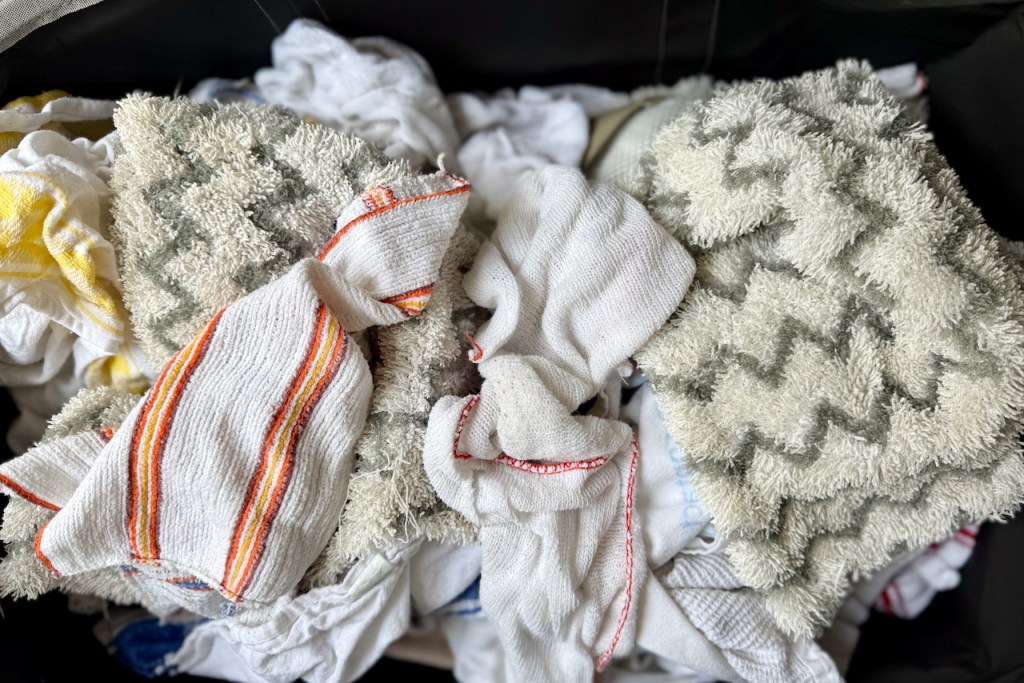
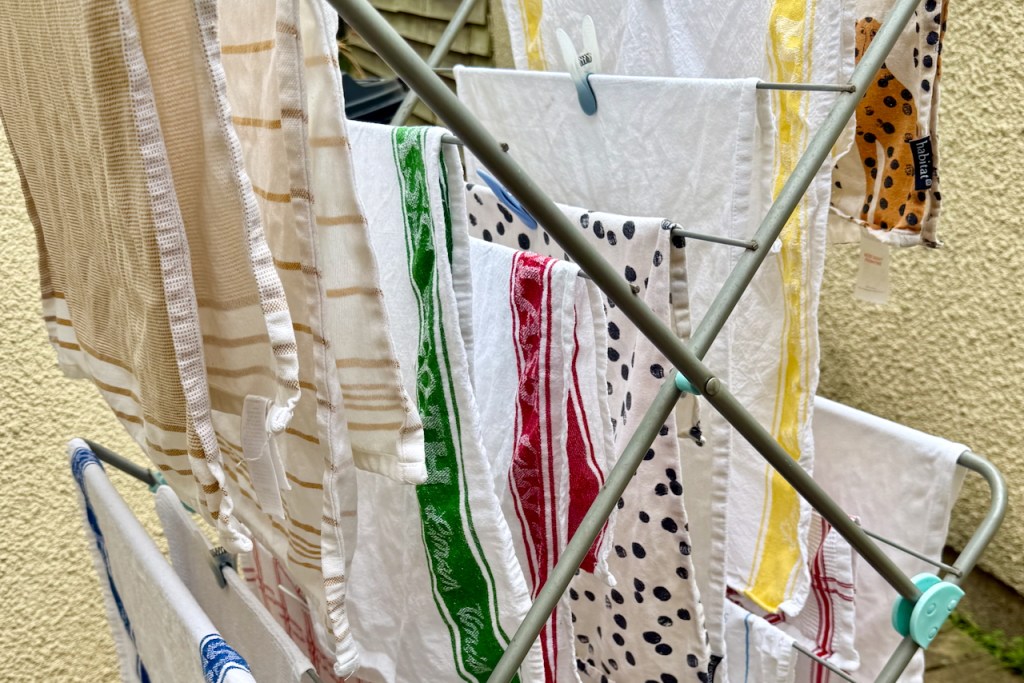
Now, I have never liked to wash rubbers together with my clothes, towels or bed linen. Call me a fussy old git but I just don’t like the idea of grease and muck rubbing up against my personals in the machine.
However, washing rubbers on their own may seem a bit of an extravagance – they hardly fill a machine after all. So, what is the solution? How can I justify washing just rubbers and nothing else on grounds of cost and environment?
The answer for me is to accumulate a larger than usual quantity of cloths and rags in the first place – enough to fill a machine once a month. Simple really.
Like most people (I suspect) I get a clean dishcloth and tea towel out of the kitchen drawer every morning. So, you’ve guessed it, I have about 30 of each – enough to last a month.
I don’t know about you but I also find I get a bee in my bonnet from time to time and feel the urge to do some extra cleaning, like the skirting boards in the kitchen or, and this is an awkward one, behind the bed. Old raggedy cloths are used for that kind of job – not ones I wash plates I eat off with as they can get full of hair, fluff, dust and cobwebs. ‘Rags’ add to the count.
I wash rubbers once a month, justified by having a month’s supply. But that is not the end of the story. How can I save even more electricity?
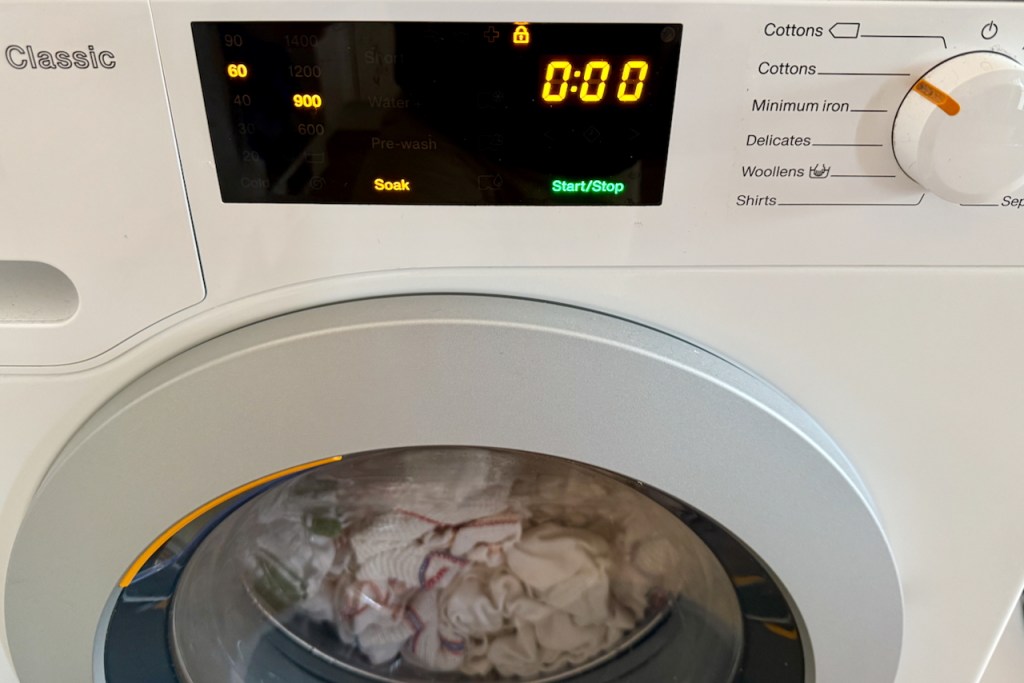
Machine set to 60 degrees and 900rpm spin.
Well, it’s a bit of a compromise. My personal belief is that rubbers should be washed at 60ºC – a higher temperature than I would normally use. That means more electricity. However, I reduce the spin from 1400rpm to 900. After all, rubbers do not need to be that dry and, once they are on the clothes horse, dry fairly quickly anyway. I use a regular washing powder and add soda crystals – great to get rid of grease. It would be daft to use fabric softener to wash rubbers; who wants their tea towels smelling of orchid and wild peacock?
So there you have it. Washing rubbers on a fixed low income. Who’d have thought it was a thing…!
As an aside, I worked four long hard summers at Devon Cleaners and Launderers in Torquay. 13-hour days in a hot steamy environment is not pleasant and the wages were low. In the summer of 1976 my diary records my wages as about £24 a week – and a pint of beer was 30p! It is highly likely that the giant machines that blew dirty hotel bed linen and towels into the wash room caused my Bells Palsy, a very unpleasant thing to endure at age 16. That is a story for another day…
#low-income #pensioner #money #energy #electricity
 Colin Anderson
Any thoughts? Leave a comment!