Hopefully you have a nice big credit on your energy account – you will need it!
It is late September and we are fast approaching the heating season. What does that mean for all of us, but especially people on a low income and who, like me, are private tenants? It can be a miserable time of year, but it needn’t be if only we could get our energy and housing policies right – not something I am discussing in this post. For now I want to focus on energy bills and how much bigger they are in the heating season – and why.
Living in a Temperate climate zone
The British Isles are ‘temperate’, meaning our homes should be less expensive to heat than homes with a ‘continental’ climate, such as in southern Germany. Sadly, that is usually not the case – for reasons I might explore in a future post, depending upon interest.
I am lucky to live in the west country. where outside temperatures – especially during the night – are amongst the mildest in Britain. Devon and Cornwall is in a Temperate Maritime climate zone which, amongst other things, means low diurnal variation in temperature – simply the difference between day and night temperatures. In winter it is usually not as warm as London during the day, but warmer than London during the night.
The stark difference between summer and winter Energy Bills
Energy bills are considerably higher in the winter compared to the summer, due largely – but not entirely – to the demand for heat. This can make it difficult to budget, especially as most of us pay a fixed monthly tariff and can build up a substantial credit at this time of year. You will need it! That credit will almost certainly be gone by the end of March.
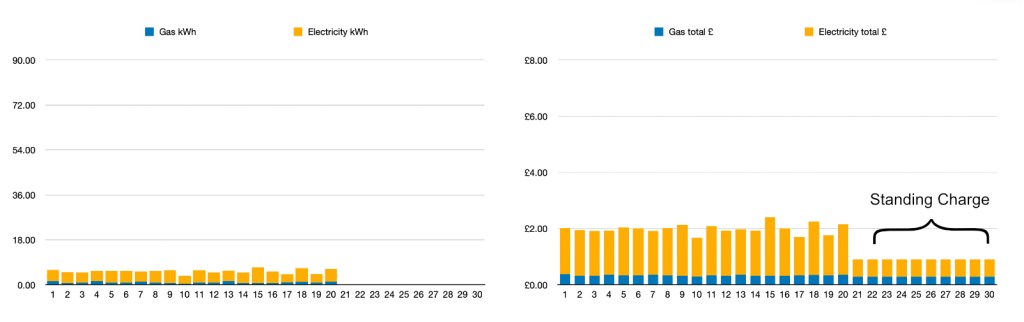
To illustrate the seasonal nature of energy bills, as well as a few other anomalies like the Standing Charge, I have reproduced below a set of graphs showing my own energy consumption. Gas is blue and electricity yellow.
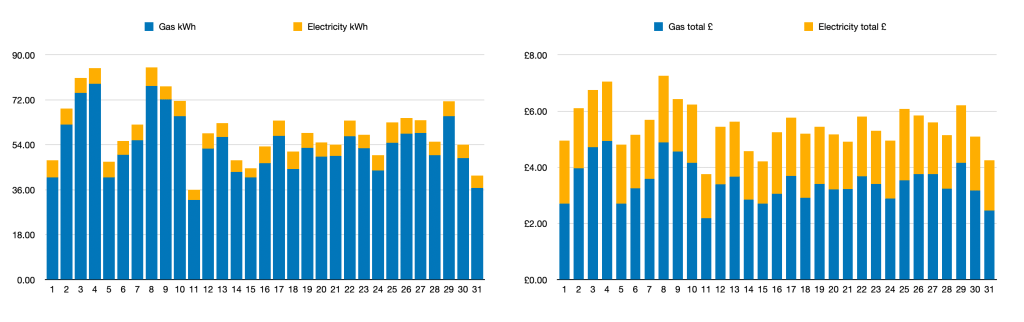
The first set of two graphs above show gas and electricity consumption (left) and prices (right) for January 2025 – pretty much the height of the last heating season – for my home, a 2-bed semi-detached bungalow with gas central heating.
Graphs below those show the same thing (and with the same scales) for September 2025.
The first thing you will notice is the whopping difference between the two sets. The heating season has a dramatic effect on energy bills! This is why you need to build up a decent amount of credit during the summer months.
You may also notice a disparity between gas use and prices and electricity use and prices, especially in the top graph. This is simply because electricity is always considerably more expensive than gas. There are reasons for this that I shan’t go into here. For the time being it is sufficient to know that electricity = expensive and gas = cheap(ish).
Why are my gas bills so high?
Simple! I have a 20-year old, inefficient gas boiler and very poor heating controls, with TRV’s (thermostatic radiator valves) that barely work and a room thermostat installed in the wrong place and which itself barely works. In fact it is utterly useless so I don’t use it.
The reason? I am a private tenant. In my experience many private tenants – where they have central heating at all – suffer the same fate as me. An inefficient, poorly designed and badly installed heating system is cheap (for the landlord) but expensive to run (for the tenant). This is just a fact of life, but particularly galling for me as an ex-energy professional.
Having said that, most of you reading this will have energy consumption graphs similar to mine regardless of whether you are a tenant or a homeowner – if you have a gas central heating system.
Now, take another look at the second set of graphs (for September 2025). What do you notice about the graph on the right? This shows my actual daily energy bill up to 20th September – so what is all the money I am spending from 21st to 30th September all about?
Standing Charge
Because I am a low energy user a large proportion of my energy bill is taken up with the Standing Charge. My energy supplier charges 91p a day for this. I am a single pensioner. What would a family of four pay? 91p a day.
And there you have it. Is it just me or does this seem unfair to you? The wealthiest person in the land will pay 91p a day. They might spend £100 a day on energy – against my £1.10 a day – but we both pay 91p Standing Charge.
I have no doubt that I will return to the Standing Charge in a future post, but for now I suspect you are fed up with hearing about it!
So how can you reduce your heating bill?
For many people like me who are on a low income and who are also private tenants there is very little you can do. In my case I will turn the heating on only when the temperature drops below 16 degrees celsius. Comfort is not a word I would associate with these temperatures, especially as I will be wearing many layers! As a private tenant you have no choice but to accept whatever heating system the landlord has provided.
Homeowners have the option of buying the most efficient heating system you can afford. The choice is enormous and not always easy to understand. One thing is for sure: in general a more efficient (and future-proof) heating system will generally be more expensive to buy than a less efficient system. However, the lifetime cost of the more expensive item may make it cheaper in the long run.
There is a huge amount of advice out there that will help save money on heating bills. Key amongst these is to invest in good heating controls that you understand and can use effectively. Monitor your consumption on smart meters. Think about the weather, especially the temperature outside. Is it sunny? If so you can benefit from solar gain – turn the heating down!
What heating system would I have?
If I could afford to buy a house I would have the best heating for human health and comfort – ambient heating. The most common ambient heating is underfloor. Underfloor heating requires a low-grade heat source and is therefore ideal for ground or air-source heat pumps. Retrofitting air-source heat pumps to an old central heating system is, in my view, not a sensible way forward in most – but not all – circumstances.
I would invest in good heating controls that are easy to use and that can be operated remotely by smartphone, tablet or home hub. In that way I could turn the heating on an hour before I expect to arrive home, saving energy when it is not needed.
The home I buy would, of course, be built to a high standard and would be airtight. In other words it would not leak air – and therefore heat (and my money). It would be insulated to a very high standard. Sadly, such homes are difficult to find in the UK as building standards are so poor, especially in comparison to countries like Germany, Sweden, Denmark, the Netherlands and so on.
My home would be the ideal but, sadly, very few Brits could afford to aspire to this, even if the volume house-builders bucked their ideas up.
So, hopefully you now have an appreciation of the dramatic increase in energy consumption that occurs in the heating season, the inefficiencies in our homes that give rise to this, how people on a low income are affected. This is a big and complex subject with many variables in play – I have just scratched the surface. Any questions?
 Colin Anderson
Any thoughts? Leave a comment!