In my first year at university I relied on a temp agency – Alfred Marks – to find me work. I may have been apprehensive at first but I came to enjoy my time at City & Guilds immensely. This post records the events of the first week in April.
Having returned from the geography field trip to Swansea on the second attempt over two days, hitching a lift having failed miserably on day one, I was right in at the deep end back home in London.
Up at 6am and down to Alfred Marks at Centre Point in search of work, immediately striking lucky and setting off for the City and Guilds of London Institute. I knew of City & Guilds; everyone did – a highly respected organisation providing a multitude of courses, examinations and qualifications in just about any trade you can think of.
I was not to know at the time but over 30 years later I would have two ‘City & Guilds’ (C&G) under my belt from short but intense courses on how to give practical energy advice – everything from how to read a meter to how to set a mechanical or electronic timer on a gas boiler.
C&G was based just off Grays Inn Road near King’s Cross and was to be my vacation workplace for the next two years. I enjoyed my time there immensely and met some very good people who became great friends.

Day 1 at City & Guilds
But on my first day – the last day of March 1976 – I had no idea what I would be doing or how I would get on. I was sent to the basement which, it turned out, was the post room, and my job seemed fairly straightforward – packing examination papers into bags and cartons ready for posting.
My first impressions were somewhat arrogant – I noted that there were six people in the team where two would have been sufficient. But these first impressions were mistaken; I would quickly learn that the job was manual and tiring – and that there was more to it than met the eye.
Wages: £16.88 per week; five days meals: 90p!
A pleasant discovery came on day 1 at 12:45 in the form of a very good subsidised staff cafeteria. I paid 90p upfront for meals for five days, and the meals were good, plentiful and filling. Coffee was free. I was liking it already.
My wages for the week – £16.88 – were paid up-front, so that first lunchtime I managed to find time to deposit my pay-cheque at the nearest bank, which was almost next door, and be back at my post in the basement at 13:45.
During the afternoon I rolled a mail-cart around the offices upstairs and started to gain an idea of just how big this organisation was and how many interesting people did who-knows-what in open-plan spaces. I was not so enamoured of my basement work colleagues at first. More fool me. It wasn’t long before they became great friends, proving me embarrassingly wrong in the process. Luckily, I kept my stupidity and embarrassment to myself.
Money in… Money out
The following morning – All Fool’s Day – started with a letter from home that was something of a double-edged sword. A surprise cheque for £44.32 from Devon County Council, which turned out to be travel expenses, and a request from my mother to pay the £20 I owed her.
John England: paying weekly for clothes
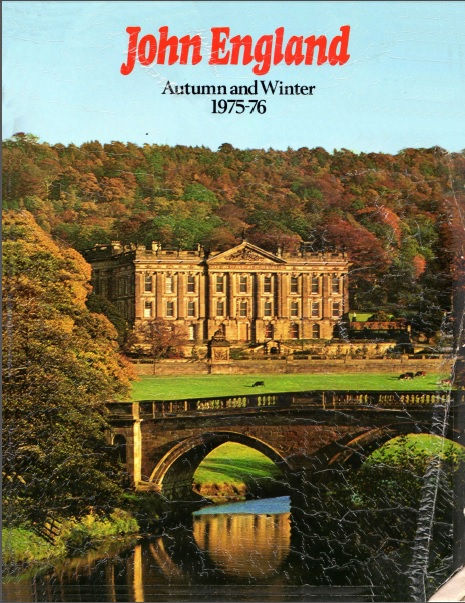
I had been buying my own clothes since starting a paper round at the age of 13. Four rounds a day – two before school and two after for the evening paper – meant I was not constrained by the conservative and dull clothing my parents provided.
I was glad of the independence, but could only afford to buy from one or other of my mother’s ‘club’ catalogues; giant heavy books that must have cost a fortune to print let alone post. Littlewoods and John England were two that I remember.
Items in these catalogues were expensive compared to paying cash on the high street. However, they allowed you to pay a modest amount over a set number of weeks – and my mother earned a commission on every purchase. So ‘affordable’ was not the right word, but the payment terms were within my means – as a paperboy.
Looking back I feel sure that the older members of my family would have ‘saved-up’ to buy almost anything, and probably told me that I should do the same. They were probably right, but my circumstances meant that saving was not really an option. And by the time I saved up for the jeans I wanted, my parents would have bought me something I would not want to be seen in. So I got into the habit of buying my own clothes, and never got into the habit of saving.
Window shopping
It seems that after my first day at work I could not resist a visit to the shops – Selfridges and Lasky’s! I had ideas above my station – and pay grade! Most people will know Selfridges but for those who may never have heard of it, Lasky’s was a well-known chain of Hi-Fi stores.
I loved music and, ever since I can remember, I took an interest in how music was made and recorded. It became very important to me to listen to music that was as close as possible to the sound that the artist intended me to hear. I was also fascinated by recording studios. You need a good Hi-Fi for that.
Back in ’76 I could only dream of one day owning a Hi-Fi system; in the mean time all I could do was browse and marvel at the selection of amplifiers, record decks, tuners and speakers. And boy did I like to marvel!
Gentle Giant & Eurovision
Within days of starting work I was queuing up at the Theatre Royal in Drury Lane to buy a ticket for the upcoming Gentle Giant gig. No online profiteering and very few ticket touts in those days! Gentle Giant were my favourite prog-rock band at the time and, perhaps ironically for some, are still now in 2026. The ticket was £1.25. Those were the days!
I also paid the rent – £6.75 – and splashed out 6p for a pudding to go with my 18p lunch!
I am pleased to say that I have never enjoyed Eurovision and have generally managed to avoid it. I like music, so why would I like Eurovision? That’s the music snob in me. Anyway, on Saturday 3rd. April Brotherhood of Man won for the UK with the perfectly hideous abomination that was Save Your Kisses For Me. Dreadful!
The day after Eurovision came a television antidote of sorts: an interview with Michael Foot on Weekend World discussing the ‘so-called’ division in the Labour Party between ‘socialist Marxists’ and ‘socialist democrats’. It seems I quite liked him, and not just because he was born in Devon!


Any thoughts? Leave a comment!